St. Patrick’s Day Business Planning: March 17 and Local Events
Revised · Calendar and planning guide
St. Patrick’s Day is observed on March 17, but a local parade or workplace activity may be scheduled separately. It is not on OPM’s federal public holiday list. For a US business, check actual opening hours, local access and staffing before making a customer notice or event plan.
Scope and time basis: United States business planning around March 17. A secondary reference supports the basic observance date and cultural context; OPM supports federal-calendar classification. No specific city’s 2027 parade, road closure, permit or transport schedule has been verified here.
March 17 and the dates you actually need
The observance’s March 17 date is separate from a particular parade, festival, venue booking or staff gathering. Use the table for the weekday of the observance and the organizer’s current notice for an event. A previous year’s event poster is not confirmation of this year’s arrangements.
| Year | Observance date |
|---|---|
| 2026 | Tuesday, March 17, 2026 |
| 2027 | Wednesday, March 17, 2027 |
| 2028 | Friday, March 17, 2028 |
| 2029 | Saturday, March 17, 2029 |
| 2030 | Sunday, March 17, 2030 |
Choose the business question first
An office may need only a normal-hours check and an optional staff note. A shop near a parade route may need to confirm delivery access and customer directions. A service team may need to review appointments, coverage and transport disruption. Pick the task that applies to your location rather than assuming every business experiences the same event.
St. Patrick’s Day is not included in OPM’s federal public holiday list. A US closure or day off must therefore come from the relevant organization’s arrangement, not from applying federal weekend observance rules to March 17. In 2029 March 17 is Saturday and in 2030 it is Sunday; those dates do not automatically create a Friday or Monday federal holiday.
Check a local event without inventing its schedule
- Identify the current-year organizer and the specific event name.
- Confirm the actual event date, start time, route or venue and any published access information.
- Use the city or transport authority’s current notice for road, stop or service changes.
- Confirm deliveries, appointments and staffing against the affected location and time window.
- Keep the checked sources and date in the event record, then review again if the organizer announces changes.
Customer notices should describe the practical change
If hours stay the same, confirm that before saying “normal hours.” If access changes, give the verified practical information, such as the affected entrance or appointment instructions. Do not state that a road is closed or a transit stop is unavailable unless the responsible source has announced it.
The template below is for your approved local arrangement. The bracketed fields need real information. If a field does not apply, omit it rather than guessing.
Service location: [name and address]
Opening hours on [date]: [confirmed hours]
Nearby event: [organizer’s actual date and time, if relevant]
Access information: [verified entrance or route advice]
Appointments or deliveries: [confirmed arrangement]
Current information source: [organizer, city or transport notice]
Keep staff activities welcoming and operationally realistic
If the team wants an optional activity, ask about interest, available time and coverage. A short heritage-learning activity or shared refreshment break can be planned without making dress, alcohol or a particular tradition the condition of participation. Check workplace rules and any food requirements before arranging refreshments.
Separate an after-work invitation from work hours and customer service duties. Confirm a venue and transport plan if a group is gathering elsewhere. This article does not announce a licensed event, establish permit requirements or determine alcohol-service rules; those questions need the actual venue and local authority.
After the day, keep a brief record of any access problem or scheduling change that affected the business. That record can help next year’s preparation, but verify the next year’s dates and notices again instead of copying old closures.
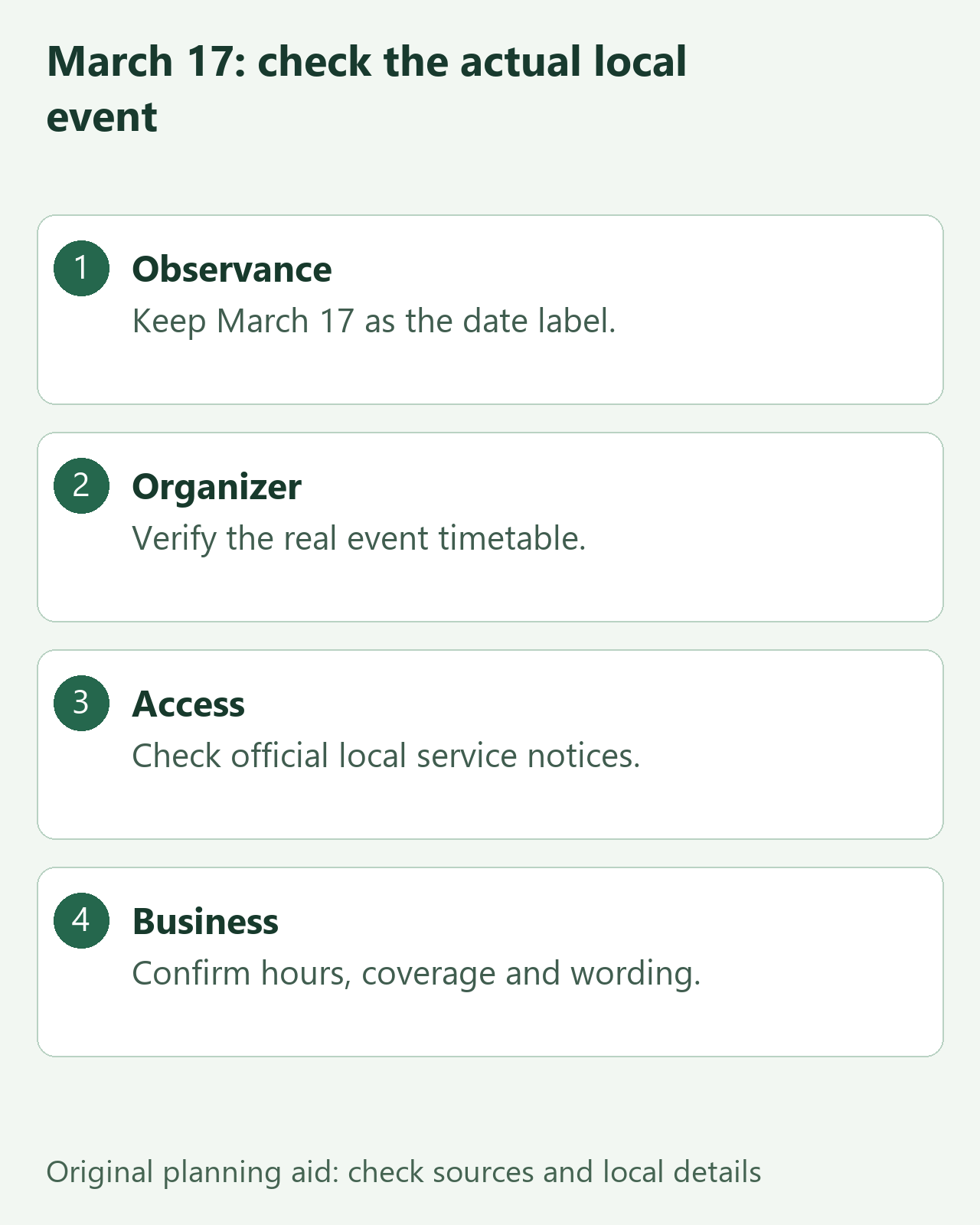
Worked planning examples
A shop is near an advertised parade route
Read the organizer’s current-year route and the city’s access notice before adjusting delivery instructions. The March 17 date alone does not prove which street is affected or when. Save the exact checked information with the business’s plan.
The parade is held on a nearby weekend
Create an event entry for the advertised weekend date and keep March 17 as the observance. Review staffing and appointments against the actual event, not only the holiday’s weekday.
An office wants an optional staff break
Check interest, coverage and workplace arrangements first. Describe the actual time and participation details. Keep customer hours accurate and avoid assuming that everyone will take part in the same tradition.
Last year’s notice is being reused
Use it as a checklist of items to verify, not as current confirmation. Recheck event date, route, transport, opening hours and contact arrangements before publishing this year’s notice.
St. Patrick’s Day local business checklist
Use the optional text record to keep verified dates, sources and local arrangements together. Leave unconfirmed information open. Downloading it does not send your completed notes to this site.
Frequently asked questions
What weekday is March 17, 2027?
Wednesday.
Is St. Patrick’s Day a US federal public holiday?
It is not on OPM’s federal public holiday list. Check the relevant employer or service schedule.
Are parades always on March 17?
This article does not establish a local event schedule. Use the organizer’s current announcement.
Can we reuse a previous year’s road-closure notice?
Use it to identify checks, then verify the current-year organizer, city and transport information before relying on it.
Choose the next planning task
Sources and what they support
- Wikipedia: Saint Patrick’s Day — secondary reference
Lead and date section used only for the March 17 observance and broad cultural context. No current local event, road closure, permit or work entitlement is inferred.
- OPM: Federal Holidays
Federal employee holiday list and year-specific usual Monday–Friday observed schedules. It does not establish every business or school schedule.
Source scope and local arrangements matter. Use the relevant organization, agency, calendar authority or astronomy service for the specific decision you are making.