Independence Day Observed 2026–2030: July 3, 4 or 5?
Revised · Calendar and planning guide
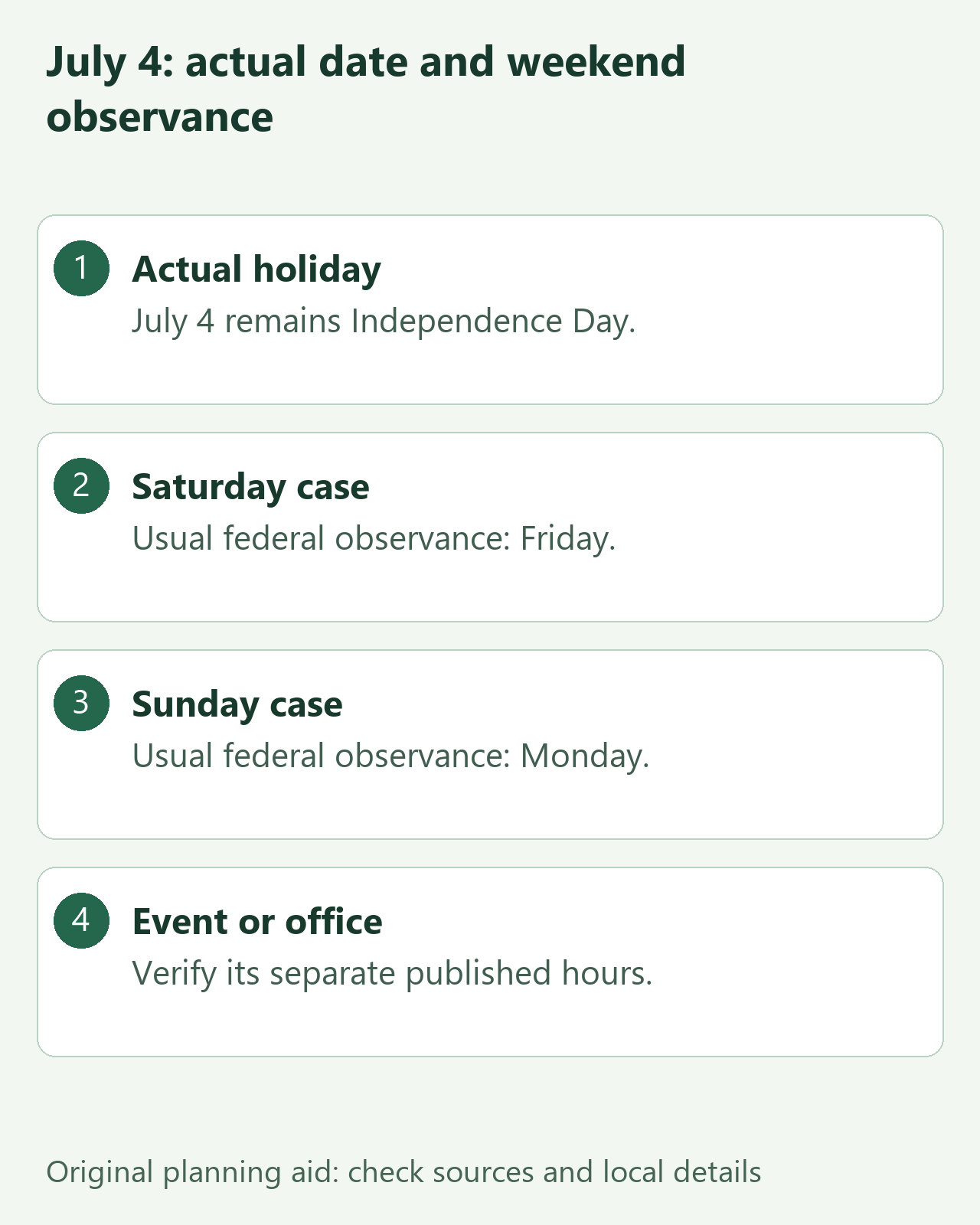
Independence Day is July 4. On the usual federal Monday–Friday calendar, the 2026 holiday is observed Friday, July 3 because July 4 is Saturday; the 2027 holiday is observed Monday, July 5 because July 4 is Sunday.
Scope and time basis: United States federal employee holiday dates under the usual Monday–Friday schedule. Employer, school, bank, court and event schedules require separate confirmation; alternative federal schedules have their own OPM rules.
Three date labels that are easy to mix up
July 4 names the actual holiday. July 3 or July 5 can be the applicable observed work-calendar date when July 4 falls on a weekend. Neither is a permanent replacement for July 4. Fireworks, parades, trips and business services can follow yet another timetable, so give those plans their own dated entries.
| Year | Actual holiday date | Federal observed date: usual Monday–Friday schedule |
|---|---|---|
| 2026 | Saturday, July 4, 2026 | Friday, July 3, 2026 |
| 2027 | Sunday, July 4, 2027 | Monday, July 5, 2027 |
| 2028 | Tuesday, July 4, 2028 | Tuesday, July 4, 2028 |
| 2029 | Wednesday, July 4, 2029 | Wednesday, July 4, 2029 |
| 2030 | Thursday, July 4, 2030 | Thursday, July 4, 2030 |
The 2026 and 2027 weekend examples
The two consecutive years demonstrate both directions of the weekend rule. In 2026 the actual date is Saturday, July 4 and the usual federal observance is Friday, July 3. In 2027 the actual date is Sunday, July 4 and the usual federal observance is Monday, July 5. OPM’s published schedules confirm both observed dates.
In 2028, 2029 and 2030 July 4 is a weekday, so the actual and usual federal observed dates coincide. A reminder that repeats every July 3 or every July 5 will not track the rule correctly. Check the year rather than reusing last year’s office-closure event.
A long weekend does not announce event times
A fireworks display can take place on July 4 or on a separately announced date. A parade has its own assembly time, route and transport arrangements. A business can choose hours that differ from federal offices. The observed holiday is useful for knowing what to verify; it is not proof of any particular display, parking closure or reopening time.
Before publishing a notice, ask which service or location it concerns. “Our service desk is closed Friday, July 3, 2026 and reopens Monday at its normal published time” is an employer-specific statement only when that schedule is actually approved. Avoid saying every service is closed throughout the weekend.
Put the dates into a useful calendar
- Add July 4 as the actual Independence Day entry.
- Add a distinct observed entry only if it affects your applicable work or service calendar.
- Include the year and affected organization in the observed entry’s description.
- Create timed invitations for a parade, display or reservation using the organizer’s current details.
- Verify any delivery, appointment or filing deadline directly with the responsible service; do not infer its rule from a general holiday table.
Check alternative workweeks before deciding leave
OPM’s in-lieu-of guidance uses the actual work schedule, including rules for a deemed Sunday and alternative schedules. The ordinary Saturday-to-Friday and Sunday-to-Monday table does not cover every federal employee, and a private employer may have different arrangements. Confirm the applicable determination rather than using a generic observed date as a pay or leave guarantee.
Worked planning examples
A reader sees July 3 in a 2026 search result
That is the usual federal observed date, not a claim that Independence Day itself moved. Keep July 4 for the actual holiday and check July 3 only for the work or service schedule that applies to your task.
A 2027 trip includes a Monday office visit
Monday, July 5 is the usual federal observed holiday in 2027. Confirm the office’s current hours before traveling and move the appointment only after checking availability. A privately operated attraction nearby may have different hours.
A fireworks invitation says Saturday, July 3
An event can use a separately announced date, but the holiday table cannot verify that invitation. Read the organizer’s current-year page for date, time, location and any changes. Do not silently convert the event to July 4 or to the observed federal weekday.
A manager edits a recurring holiday entry
Inspect whether the entry is intended to track July 4 or the year-specific office closure. Keep the actual holiday recurring on July 4; record the employer-approved observed dates separately or use a checked calendar source that correctly represents that rule.
July 4 holiday, closure and event record
Use the optional text record to keep verified dates, sources and local arrangements together. Leave unconfirmed information open. Downloading it does not send your completed notes to this site.
Frequently asked questions
Is Independence Day July 3 in 2026?
The actual holiday is July 4. Friday, July 3 is the usual federal observed date in 2026.
Why is July 5 listed in 2027?
July 4 is Sunday, so the usual federal Monday–Friday calendar observes it on Monday, July 5.
Are July 3, July 4 and July 5 all federal holidays?
This table identifies one actual holiday and its applicable observed date. It does not designate all three as separate federal holidays.
Does the holiday table prove a fireworks schedule?
No. Use the organizer’s current announcement for the event’s actual date and time.
Choose the next planning task
Sources and what they support
- OPM: Federal Holidays
Federal employee holiday list and year-specific usual Monday–Friday observed schedules. It does not establish every business or school schedule.
- OPM: Federal Holidays — In Lieu Of Determination
Full-time federal employee in-lieu-of rules, alternative workweeks and the distinction for part-time and intermittent employees. Individual arrangements require the agency determination.
- USNO: Federal Holidays
Fixed dates and weekday rules, including June 19, July 4, December 25 and the last Monday in May. The weekdays in these guides are Gregorian-calendar calculations.
Source scope and local arrangements matter. Use the relevant organization, agency, calendar authority or astronomy service for the specific decision you are making.