Full Moon Calendar 2027: USNO Dates, Times and Local Planning
Revised · Calendar and planning guide
The U.S. Naval Observatory lists 12 full moons in 2027. The table below preserves its published Universal Time dates and minute-resolution times, with an approximate New York comparison so you can see when the local calendar date differs.
Scope and time basis: 2027 astronomical Full Moon instants from USNO API v4.0.1, captured on 2026-11-04. UT in the USNO astronomy data means UT1. Local civil comparisons approximate UT1 as UTC at minute resolution and use current America/New_York time-zone rules; they are not second-precision predictions or moonrise times.
All 2027 full moons
Read the time-scale heading before copying a date to your calendar. USNO’s table gives one worldwide phase instant, not a separate full moon for each city. All times below use a 24-hour clock. The New York column is an approximate local civil comparison, including EST or EDT as applicable.
| Month | USNO source date and time (UT1) | Approximate New York date and time |
|---|---|---|
| January | 2027-01-22 12:17 UT1 | 2027-01-22 07:17 EST |
| February | 2027-02-20 23:23 UT1 | 2027-02-20 18:23 EST |
| March | 2027-03-22 10:44 UT1 | 2027-03-22 06:44 EDT |
| April | 2027-04-20 22:27 UT1 | 2027-04-20 18:27 EDT |
| May | 2027-05-20 10:59 UT1 | 2027-05-20 06:59 EDT |
| June | 2027-06-19 00:44 UT1 | 2027-06-18 20:44 EDT |
| July | 2027-07-18 15:45 UT1 | 2027-07-18 11:45 EDT |
| August | 2027-08-17 07:29 UT1 | 2027-08-17 03:29 EDT |
| September | 2027-09-15 23:03 UT1 | 2027-09-15 19:03 EDT |
| October | 2027-10-15 13:47 UT1 | 2027-10-15 09:47 EDT |
| November | 2027-11-14 03:26 UT1 | 2027-11-13 22:26 EST |
| December | 2027-12-13 16:09 UT1 | 2027-12-13 11:09 EST |
Why the New York date sometimes differs
The June full moon is June 19 at 00:44 UT1 in the source table; the approximate New York comparison is June 18 at 20:44 EDT. The November full moon is November 14 at 03:26 UT1; the New York comparison is November 13 at 22:26 EST. A one-day difference in those date labels does not imply two different full moons.
The distinction also works eastward. The July 18 phase at 15:45 UT1 corresponds approximately to July 19 at 00:45 in Tokyo. If you need another location, use a named time zone and the rules for that date. Do not apply one fixed summer or winter offset to every row.
How the times and comparisons were obtained
The source request asked USNO for all primary phases in 2027. Its response contained 49 primary-phase entries; this page selects the 12 entries labeled “Full Moon” and retains their source date and time. The other entries are new moons and quarter phases, not additional full moons.
USNO’s API documentation labels the phase times Universal Time, and its time explanation defines astronomical UT as UT1. UT1 and UTC are distinct time scales. USNO describes their permitted difference as less than one second; treating the supplied UT1 minutes as approximate UTC is suitable for these calendar-date comparisons, but not for an exact-second calculation. Seconds set to zero in the conversion are a computational placeholder, not published measured seconds.
The local examples follow current time-zone rules. Recheck if those rules change before your event. For precise scientific work, use the source time scale and the relevant current time data rather than treating this planning table as an exact UTC ephemeris.
Use a phase date to plan a viewing window
An exact full moon is a phase instant. It does not tell you when the Moon rises at your location, whether the horizon is clear, or whether clouds will obscure it. USNO notes that the Moon can look nearly full for several nearby nights, which can make a practical observation plan more flexible than the exact instant alone.
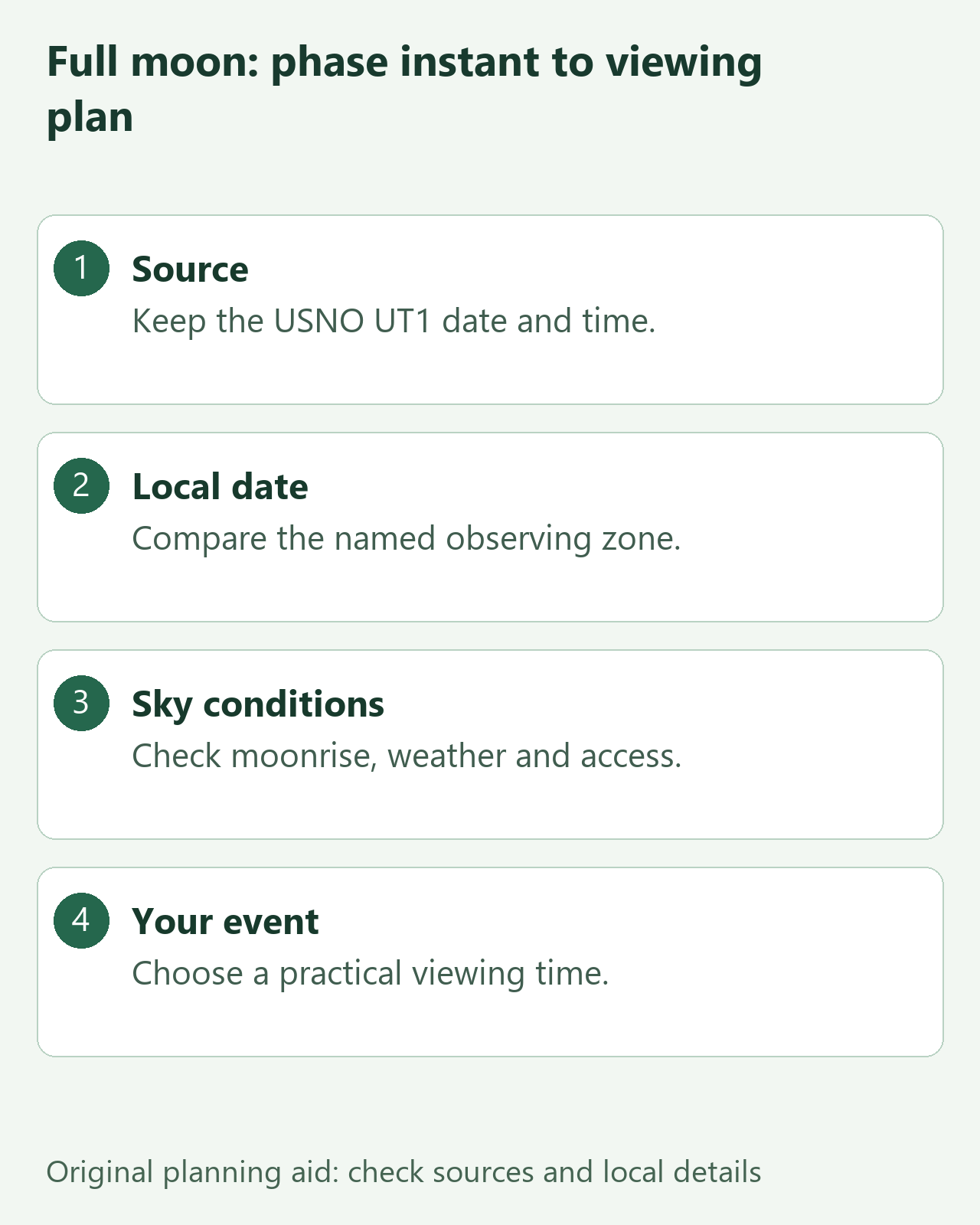
- Choose the full-moon row and the place where you will observe.
- Convert the source instant using the location’s named time zone if a local date matters.
- Check local moonrise and moonset data, weather, horizon and access arrangements.
- Make a timed calendar event for your chosen observation, not simply for the worldwide phase instant.
- Keep a backup evening if the purpose allows it; record what was actually visible rather than assuming the phase guarantees a view.
Full-moon names are a separate convention
The USNO response labels the astronomical phase “Full Moon”; it does not assign a traditional monthly name. Names found on calendars can reflect particular regional, seasonal or cultural conventions. They do not change the phase instant. If a name matters to your project, record the naming source separately instead of treating it as additional USNO data.
This calendar does not infer health, behavior, weather or luck from a full moon. For a lesson or photograph, the date, time basis and actual observing conditions are the useful starting points.
Download the 2027 full-moon table
The CSV preserves the USNO source dates and times as UT1 and labels the New York comparisons approximate. It contains 12 full-moon rows; it does not contain moonrise or weather predictions.
Worked planning examples
Two calendars show June 18 and June 19
Compare the time bases before calling one wrong. The source instant is June 19, 2027 at 00:44 UT1. In the approximate New York comparison it is still June 18 at 20:44 EDT. Both can describe the same phase instant with different civil date labels.
You want to photograph the July full moon in Tokyo
The July source instant is July 18 at 15:45 UT1, approximately July 19 at 00:45 in Tokyo. Then check Tokyo-area moonrise, weather, horizon and the chosen venue. The exact phase instant alone does not determine a good shooting time.
An app says the Moon looks full the previous evening
USNO explains that illumination changes slowly near full moon and the disk may appear nearly full on nearby nights. Keep the exact phase instant separate from the evening you actually observe; the visual description need not be an exact phase-time claim.
You download the table for a classroom calendar
Keep the UT1 heading with the source values and the approximation note with New York values. If students record another location, add that named zone and conversion method. Do not label the source times “local” or treat them as moonrise times.
Full-moon observation planning record
Use the optional text record to keep verified dates, sources and local arrangements together. Leave unconfirmed information open. Downloading it does not send your completed notes to this site.
Frequently asked questions
How many full moons are in the 2027 USNO year response?
Twelve entries are labeled Full Moon. The response contains 49 entries across all four primary phases.
Are the main source times local times?
No. They are USNO Universal Time values, interpreted as astronomical UT1. The separate New York column is an approximate civil comparison.
Does the exact full-moon time tell me moonrise?
No. Moonrise depends on location and date. Use the relevant local rise/set service.
Why are traditional moon names not in the data table?
The USNO response supplies the phase name Full Moon, date and time. A traditional monthly name requires a separately identified naming convention.
Choose the next planning task
Sources and what they support
- USNO: Primary Moon Phases for 2027
Captured year response: API v4.0.1, 49 primary-phase entries, including 12 Full Moon entries. Source dates and times are retained in UT1.
- USNO: Astronomical Applications API documentation
Year endpoint and phase field definitions, including the Universal Time label. Only the relevant phase-data section is used here.
- USNO: Universal Time
Astronomical UT1 versus civil UTC and the subsecond distinction. Local table comparisons approximate UT1 as UTC at minute resolution; they are not exact-second times.
- USNO: Phases of the Moon
Definitions of phases, their worldwide instants, average cycle length and appearance on nearby nights. A phase instant is separate from local moonrise or a visible crescent.
Source scope and local arrangements matter. Use the relevant organization, agency, calendar authority or astronomy service for the specific decision you are making.