Printable Lunar Calendar: An Undated Month and Observation Record
Revised · Calendar and planning guide
Use this undated six-week month worksheet to record moon-phase dates and actual observations. Fill in the month, year and date numbers first. It is a blank planning aid, not a precomputed lunar calendar or a table of religious or traditional calendar dates.
Scope and time basis: Original printable worksheet and USNO moon-phase explanations. The worksheet contains no automatically calculated dates, moonrise predictions or lunar-calendar conversions. Use a dated source before adding a phase.
Set up the blank month
Write the month, year and observing location on your printed copy. Find the weekday of the first day using a checked Gregorian calendar, then number the date boxes from that weekday. Leave the boxes before day 1 and after the last day blank; a month can have 28, 29, 30 or 31 days. The six-row sheet provides space without pretending that every month starts on Sunday or has 31 days.
| Sun | Mon | Tue | Wed | Thu | Fri | Sat |
|---|---|---|---|---|---|---|
| ____________ | ____________ | ____________ | ____________ | ____________ | ____________ | ____________ |
| ____________ | ____________ | ____________ | ____________ | ____________ | ____________ | ____________ |
| ____________ | ____________ | ____________ | ____________ | ____________ | ____________ | ____________ |
| ____________ | ____________ | ____________ | ____________ | ____________ | ____________ | ____________ |
| ____________ | ____________ | ____________ | ____________ | ____________ | ____________ | ____________ |
| ____________ | ____________ | ____________ | ____________ | ____________ | ____________ | ____________ |
Three things to keep separate
A Gregorian date is a civil calendar label, such as June 18, 2027 in New York. An astronomical phase is an instant, such as the full moon at June 19, 2027, 00:44 UT1. A date in a particular lunar or lunisolar calendar follows that calendar’s own rules and cannot be read directly from a generic phase picture.
A new-moon calculation and a first visible crescent are also different observations. USNO’s phase explanation describes the thin visible crescent as relevant to the Islamic calendar, while the astronomical New Moon is defined by celestial geometry. Use the appropriate calendar authority or sighting criteria if that calendar’s date is your actual question.
Add sourced phases to the correct boxes
Start with a phase-date source such as USNO. Keep its time-scale label with the value. If a local date is needed, convert using the observing location’s named time zone and state the time basis. The linked 2027 full-moon guide preserves USNO UT1 values and explains its approximate civil comparisons.
For example, the June 2027 full moon is June 19 at 00:44 UT1 in the source, approximately June 18 at 20:44 EDT in New York. A New York observation worksheet can put that local comparison in the June 18 box, while retaining the source instant in a note. Do not write both as if they were separate full moons.
- Fill in the month, year, first weekday and actual number of days.
- Choose an observing location and named time zone.
- Copy each phase with its source date, time and time-scale label.
- Add a clearly labeled local comparison only when you need one.
- Record actual observation time, appearance and weather separately from the predicted phase.
- For outdoor plans, check local moonrise, access and conditions before choosing a viewing time.
Use a simple legend
Use one symbol for a sourced primary phase and a different mark for an observation you actually made. A cloud note can explain why you saw nothing even on a predicted full-moon date. Leave an unverified box blank rather than filling the month by repeating a rounded 29.5-day cycle. USNO’s average phase cycle length does not give every month’s exact phase dates.
The worksheet is useful for comparing predictions with observations. It does not infer personal health, luck, weather or gardening outcomes from lunar phases. If you add a traditional moon name or another calendar’s date, include the separate source and convention.
Print and reuse the worksheet
Use your browser’s print preview and choose an orientation and scale that keep the seven columns legible. Inspect the preview before printing: date boxes, headings and your handwritten note space should fit. The download below is a plain-text companion record for source and observation notes, not an automatically filled PDF or a completed lunar calendar.
For a dated 2027 full-moon table, open the companion guide and its downloadable CSV. Keep a fresh blank worksheet for each month; reusing an old numbered sheet can silently carry the wrong first weekday into a new year.
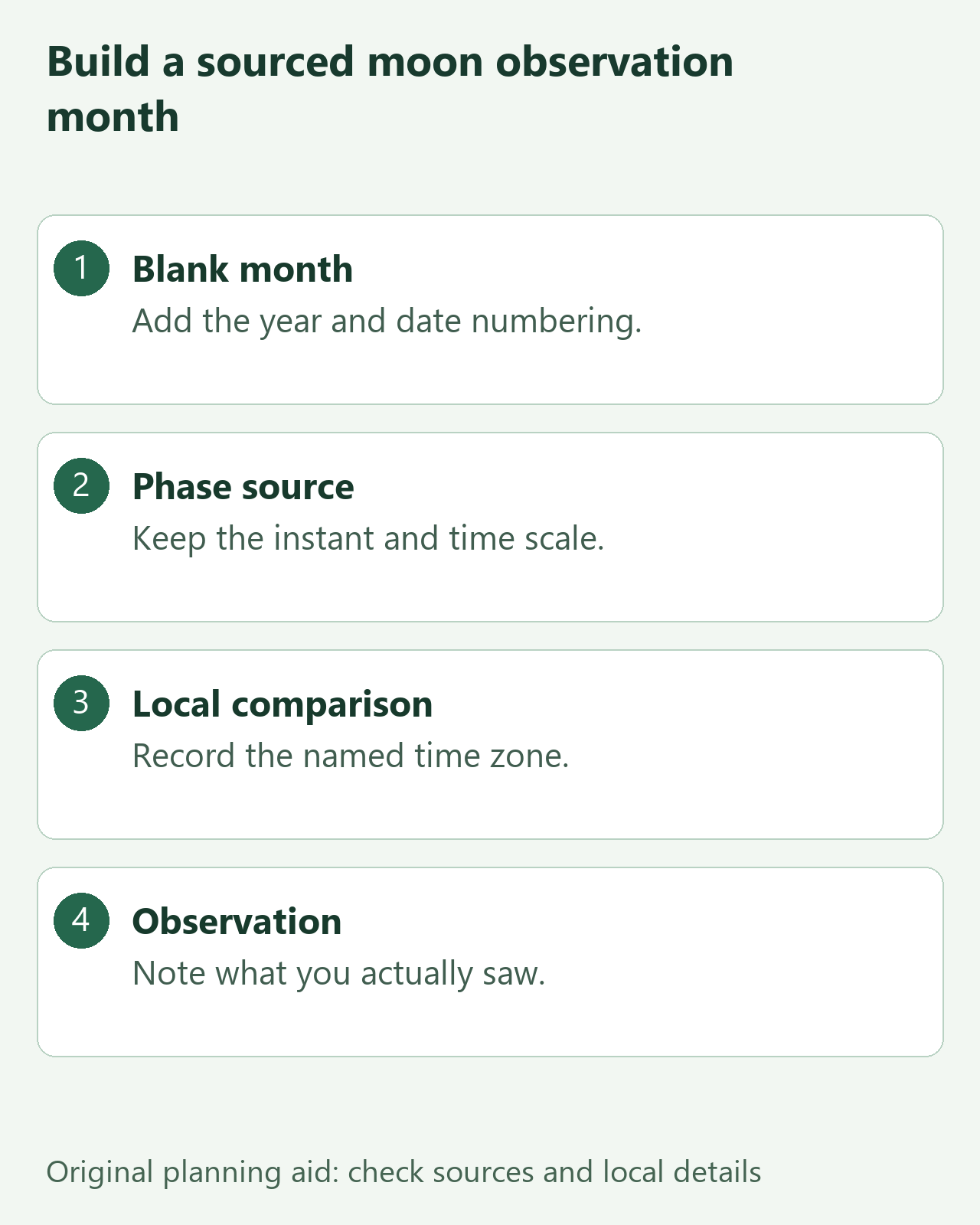
Worked planning examples
You are preparing February in a non-leap year
Number only the 28 actual dates from the correct first weekday. Leave the remaining boxes blank. The six-week template provides space; it does not assert that February has 42 or 31 days.
A full-moon source and your phone show different dates
Check the source time scale and the phone’s location zone. A worldwide phase instant near midnight can fall on another local date. Record both with clear labels; do not assume two date labels mean two phases.
You want a traditional lunar-calendar date
Use a source for that specific calendar and its rules. The worksheet’s Gregorian boxes and astronomical phase notes do not perform a lunar or lunisolar calendar conversion.
Clouds prevent the planned observation
Keep the sourced phase entry and record the failed observation separately, including time and conditions. A phase prediction is not proof that the Moon was visible from your location.
Lunar month source and observation record
Use the optional text record to keep verified dates, sources and local arrangements together. Leave unconfirmed information open. Downloading it does not send your completed notes to this site.
Frequently asked questions
Is this worksheet already dated?
No. Add the month, year, first weekday and date numbers before use.
Does it calculate Chinese or Islamic calendar dates?
No. Use the appropriate calendar source or authority for those dates.
Can I fill phases by repeating a 29.5-day interval?
Use actual phase data. USNO describes 29.5 days as an average cycle, not an exact schedule for every date.
Where can I get the actual 2027 full-moon dates?
Open the linked 2027 full-moon guide for the USNO table, time-scale notes and downloadable CSV.
Choose the next planning task
Sources and what they support
- USNO: Phases of the Moon
Definitions of phases, their worldwide instants, average cycle length and appearance on nearby nights. A phase instant is separate from local moonrise or a visible crescent.
- USNO: Primary Moon Phases for 2027
Captured year response: API v4.0.1, 49 primary-phase entries, including 12 Full Moon entries. Source dates and times are retained in UT1.
- USNO: Universal Time
Astronomical UT1 versus civil UTC and the subsecond distinction. Local table comparisons approximate UT1 as UTC at minute resolution; they are not exact-second times.
Source scope and local arrangements matter. Use the relevant organization, agency, calendar authority or astronomy service for the specific decision you are making.