Practical guide
Why Can a New Moon Fall on Different Calendar Dates?
The astronomical new moon is one phase instant, but a calendar displays its date in a chosen time zone. A USNO entry for 9 November 2026 at 07:02 Universal Time corresponds approximately to 8 November at 23:02 in Los Angeles and 9 November at 16:02 in Tokyo. Compare two sourced 2026 examples, keep the time scale and minute precision visible, and distinguish a phase calculation from a first-crescent sighting.
One astronomical phase can have more than one local date
Astronomical new moon is a defined phase, not an entire calendar day. USNO explains the primary phases in terms of the Moon’s apparent ecliptic longitude relative to the Sun. At new moon, those longitudes are the same. For practical calendar purposes, observers in different locations refer to the same phase instant.
A calendar then assigns a date using a time basis. A Universal Time table, a Tokyo calendar and a Los Angeles calendar can put that same instant in different daily boxes. Changing the box does not move the physical event or create another lunar cycle. It changes the local clock and date used to label it.
Start a comparison with a place or a named time zone rather than a country alone. Some countries span several zones. Also establish whether the calendar means astronomical new moon, a civil lunar-calendar label, or a first visible crescent. Those are not interchangeable definitions.
Read the source time and its precision before converting
The USNO primary-phase API for 2026 lists the November new moon as 9 November 2026, 07:02 Universal Time and the September new moon as 11 September 2026, 03:27 Universal Time. These are computed phase entries published to the minute. They are not observations made by this website.
USNO’s Universal Time explanation distinguishes Earth-rotation UT1, used for its astronomical Universal Time entries, from atomic UTC, used for civil clocks. The traditional UTC relationship described there keeps the scales close, but they are not identical. Do not rename the source values as exact UTC seconds.
For the civil-date examples below, we use each printed UT minute as an approximate UTC reference, then apply the zone’s offset for that date. Displayed clock times are approximate to the source minute. Entering 00 seconds in a converter is only a computational placeholder; it does not supply an observed second. These examples illustrate calendar-date differences well away from midnight. A source value close to a date boundary, or a task needing accurate seconds, requires suitable ephemeris precision and time-scale conversion data.
The local conversions were checked with IANA time-zone data version 2026f. Time-zone policies can change, so retain the event year and update your time-zone software when preparing another year. The source links make the November and September values reproducible; this page is a worked comparison, not a live “next new moon” service.
November 2026: Los Angeles has the previous calendar date
| Place and zone | Local calendar date | Approx. local clock time | Offset on that date |
|---|---|---|---|
| UTC reference | 9 November 2026 | 07:02 | +00:00 |
| Los Angeles — America/Los_Angeles | 8 November 2026 | 23:02 PST | −08:00 |
| New York — America/New_York | 9 November 2026 | 02:02 EST | −05:00 |
| Kathmandu — Asia/Kathmandu | 9 November 2026 | 12:47 | +05:45 |
| Tokyo — Asia/Tokyo | 9 November 2026 | 16:02 JST | +09:00 |
| Auckland — Pacific/Auckland | 9 November 2026 | 20:02 NZDT | +13:00 |
Subtract eight hours from the approximate UTC reference for Los Angeles: 07:02 minus 08:00 passes midnight and becomes 23:02 on 8 November. Add nine hours for Tokyo: 07:02 plus 09:00 becomes 16:02 on 9 November. Both rows label the same new moon.
Kathmandu adds five hours and forty-five minutes, not just five hours. Auckland uses a thirteen-hour daylight-saving offset for this date. New York remains on 9 November at approximately 02:02. These differences show why a country name, a familiar abbreviation or a whole-hour assumption is an incomplete conversion method.
Use the zone identifier to reproduce the row in date-aware software. The offset column describes this particular event date; it is not a promise that Los Angeles is always UTC−08:00 or Auckland always UTC+13:00.
Follow one event across the date boundary
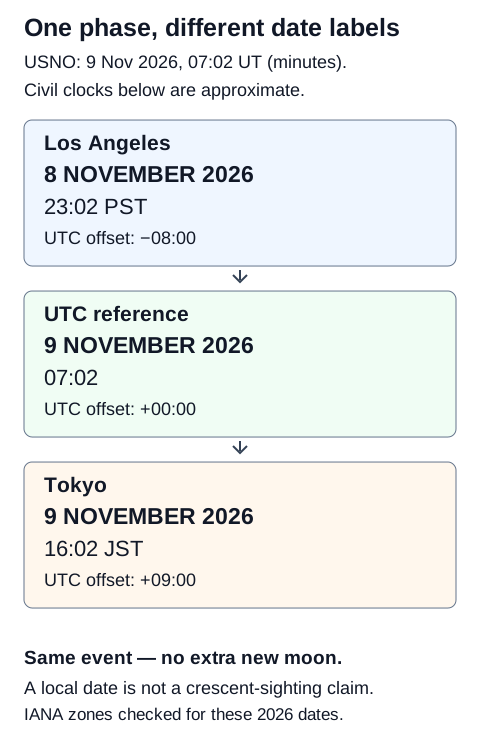
The arrows connect equivalent labels; they do not show the Moon travelling from one city to another. Reading down the diagram changes the clock used to name an instant. It does not add elapsed time between three new moons.
If you print a local calendar, state the zone used for its moon-phase labels. If you share the phase as a timed calendar event, retain its time basis and let the calendar software show the recipient’s local time. An all-day date and a timed astronomical instant have different meanings. See the all-day calendar-date guide when an import changes a date-only entry; that is a separate problem from the astronomical conversion here.
September 2026: use the offset for the actual date
| Place and zone | Local calendar date | Approx. local clock time | Offset on that date |
|---|---|---|---|
| UTC reference | 11 September 2026 | 03:27 | +00:00 |
| Los Angeles — America/Los_Angeles | 10 September 2026 | 20:27 PDT | −07:00 |
| New York — America/New_York | 10 September 2026 | 23:27 EDT | −04:00 |
| Kathmandu — Asia/Kathmandu | 11 September 2026 | 09:12 | +05:45 |
| Tokyo — Asia/Tokyo | 11 September 2026 | 12:27 JST | +09:00 |
| Auckland — Pacific/Auckland | 11 September 2026 | 15:27 NZST | +12:00 |
In September, Los Angeles uses PDT at UTC−07:00 and New York uses EDT at UTC−04:00. Their local dates are both 10 September. Auckland uses NZST at UTC+12:00. Compare those offsets with November’s PST, EST and NZDT rows before reusing a conversion.
Daylight saving changes the conversion offset; it does not change the source new-moon instant. Copying a November offset into a September calculation can produce the wrong clock time, even if it happens to leave the daily label unchanged. Conversely, a one-hour difference near midnight can change the local date.
The IANA Time Zone Database models local-time history and is updated for changes in boundaries, offsets and daylight-saving rules. Use the dated rules for a named zone. Avoid a reusable shortcut such as “all US times are eight hours behind UTC,” and avoid using a current offset for a historical or future date without checking the applicable rule.
New moon does not promise a visible new crescent that evening
At new moon, the Earth-facing side is largely unlit and the Moon is near the Sun in our sky. NASA’s moon-phase explanation describes why we usually do not see the new moon directly. A thin illuminated crescent seen after new moon is a later appearance, not the phase instant listed in the table.
USNO’s crescent-visibility explanation describes the role of location and observing circumstances. Horizon, sky conditions and the observer matter. A fixed rule such as “everyone will see the crescent after this many hours” cannot guarantee a sighting. A date conversion does not establish whether the Moon is above your horizon or visible in twilight.
If your task concerns a calendar tradition that uses a crescent sighting or an authority’s declared month start, consult the relevant calendar authority and its stated method. Keep that question separate from a geocentric new-moon ephemeris. This page supplies no religious date ruling, eclipse prediction or observing report.
Nor should you build an annual table by adding a fixed 29 or 30 days repeatedly. The average phase cycle is about 29.5 days, but individual phase intervals and local daily labels do not follow one exact month-length shortcut. Fetch the appropriate year’s phase data for the task.
A five-step check when calendars disagree by a day
- Match the event. Check the phase name and year. A new-moon entry and a first-crescent label may intentionally describe different events.
- Keep the original record. Copy the source date, clock time, named time scale and stated precision. Do not manufacture missing seconds.
- Identify the displayed zone. Look for a city or IANA zone such as America/Los_Angeles, and ask the publisher when a date-only calendar gives no time basis.
- Use the event date’s offset. Include daylight-saving rules and fractional-hour offsets. Calculate across midnight rather than changing only the clock digits.
- Compare equivalent labels. Check the local date and approximate clock time together. If the calendars still disagree after matching definitions and time bases, preserve both source records and investigate the specific discrepancy.
A matching date alone does not prove a shared time basis: many zones can place a phase in the same day. A different date alone does not prove one calendar is wrong. The useful evidence is the underlying event record and the rule used to display it.
For a date-only printable, write its zone in the legend. For a timed event, keep the timestamp and time basis in the source notes. For an observing activity, add a separate local viewing plan rather than treating the phase table as a visibility forecast.
Six practical date-comparison decisions
These invented cases apply the sourced examples and their limits. Choose the next check before opening each answer. They are practice situations, not observations or calendar errors reported by named publishers.
Case 1
A USNO table says 9 November 2026, 07:02 UT. A Los Angeles calendar marks the new moon on 8 November. Must one of them be wrong?
Show answer and explanation for case 1
No. First compare the time basis and location for the same phase.
The USNO entry is a Universal Time entry. With the approximate UTC comparison used here, subtracting the Los Angeles offset of eight hours gives 23:02 on 8 November. The local date rolls back because the calculation passes midnight, not because Los Angeles experiences an extra new moon. Check the year, phase, time scale and named zone on both calendars. If the Los Angeles publisher is actually claiming 9 November at a different instant, investigate that claim separately; a one-day difference by itself is not proof of a bad ephemeris.
Case 2
For the September example, someone subtracts eight hours from 03:27 and gets 19:27 in Los Angeles. What needs correcting?
Show answer and explanation for case 2
Use the offset for 11 September 2026: Los Angeles is on PDT, UTC−07:00.
The correct approximate local result is 20:27 on 10 September. Eight hours is the November standard-time offset in our first example, not a year-round Los Angeles rule. The date happens to remain the previous day in this mistake, but the clock time is still wrong. A matching date does not validate the conversion. Use America/Los_Angeles and the actual event date in current time-zone software, then compare the offset and time as well as the day. Do not copy PST into a summer row just because it is a familiar abbreviation.
Case 3
A worksheet converts 07:02 to Kathmandu by adding five hours and writes 12:02. Is the whole-hour method adequate?
Show answer and explanation for case 3
No. Kathmandu uses +05:45 for this example, giving approximately 12:47 on 9 November.
Include the forty-five minutes in the calculation. Time-zone offsets are not always whole numbers of hours, and a missed fraction can matter near a date boundary. Record Asia/Kathmandu as the zone rather than asking a tool to guess from an abbreviation. Keep the original USNO minute value next to the local comparison so another reader can reproduce it. This example still lands on 9 November, but that unchanged date is not a reason to accept the wrong clock time or to generalize a whole-hour rule to other locations.
Case 4
A calendar shows the astronomical new moon on Monday. Can a teacher promise that everyone will see a new crescent on Monday evening?
Show answer and explanation for case 4
No. The phase instant and the first visible crescent answer different questions.
The astronomical new moon is defined by the Sun–Moon longitude relationship. A first crescent sighting depends on the observer’s location and viewing circumstances, including the horizon and sky conditions. USNO explains why one universal age or date cannot guarantee visibility. Use the ephemeris for the phase and a separately appropriate observing resource for a viewing plan. Label an illustration as an illustration; do not turn this table into a sky-observation report, a religious calendar ruling or a promise that a particular evening will provide a visible crescent.
Case 5
Two calendars say 9 November for a new moon, but neither lists a city or time zone. Have you verified that they use the same definition?
Show answer and explanation for case 5
No. A matching day label can hide different time bases or different events.
Ask for the underlying phase timestamp, its year and time scale, the zone used for the displayed date, and whether the label means conjunction or a crescent-based calendar convention. Many offsets can produce the same local date for this November example. That agreement alone does not establish that either calendar uses your location or even the same event definition. A date-only box can be useful for a stated calendar, but retain the source record if you intend to compare it with another publisher or move it into a shared schedule.
Case 6
The ephemeris gives 07:02 UT. A converter requires seconds, so someone enters 07:02:00 and calls it the exact observed UTC time. Is that claim supported?
Show answer and explanation for case 6
No. Keep the published minute precision and distinguish UT1 from UTC.
USNO’s Universal Time explanation distinguishes Earth-rotation UT1 from civil UTC. The zeros supplied to a converter are a computational placeholder, not a measured event second or evidence of an observation. Our tables use that minute as an approximate UTC reference for a civil-date comparison, with their precision stated. For work near a midnight boundary or requiring accurate seconds, obtain appropriate time-scale conversion data and ephemeris precision rather than expanding the printed value with invented accuracy. A neatly formatted timestamp does not create information absent from the source.
Download the comparison sheet and keep its source labels
Download the cross-day comparison SVG or the new-moon local-date comparison sheet. The sheet contains both six-zone examples, the original UT minute entries, a blank record for another event and all six practice answers.
Keep the year, time scale, zone and precision attached when you reuse a row. The examples do not supply every new moon in 2026, any 2027 full-moon dates, or a local crescent-sighting calendar. Use the USNO primary-phase data service to obtain the appropriate event record instead of extrapolating these dates.
A useful comparison lets another reader reconstruct the result and understand its limits. State which daily label is local, which time is the original source value, and whether the purpose is a phase calendar, a timed schedule or a viewing activity.
Sources and further reading
- US Naval Observatory: Dates of Primary Phases of the MoonPrimary-phase data service, supported years and Universal Time minute output.
- US Naval Observatory: 2026 primary-phase API dataActual new-moon entries for 9 November 07:02 UT and 11 September 03:27 UT; API version 4.0.1 and 50 phase records.
- US Naval Observatory: Phases of the MoonPrimary phases as defined instants, longitude relationship and shared astronomical phase for practical observer comparisons.
- US Naval Observatory: Universal TimeUT1 and UTC distinction; do not present the published UT minute as exact UTC seconds.
- US Naval Observatory: Crescent Moon VisibilitySeparate visibility question; dependence on observer location and conditions, without a universal guaranteed sighting age.
- NASA: Moon PhasesNew-moon illumination and appearance, crescent distinction and approximate phase-cycle length.
- IANA: Time Zone DatabaseDate-aware named-zone rules and policy updates; version 2026f checked for the example conversions.