Daylight Saving Time Starts 2026–2030: US Clock-Change Dates
Revised · Calendar and planning guide
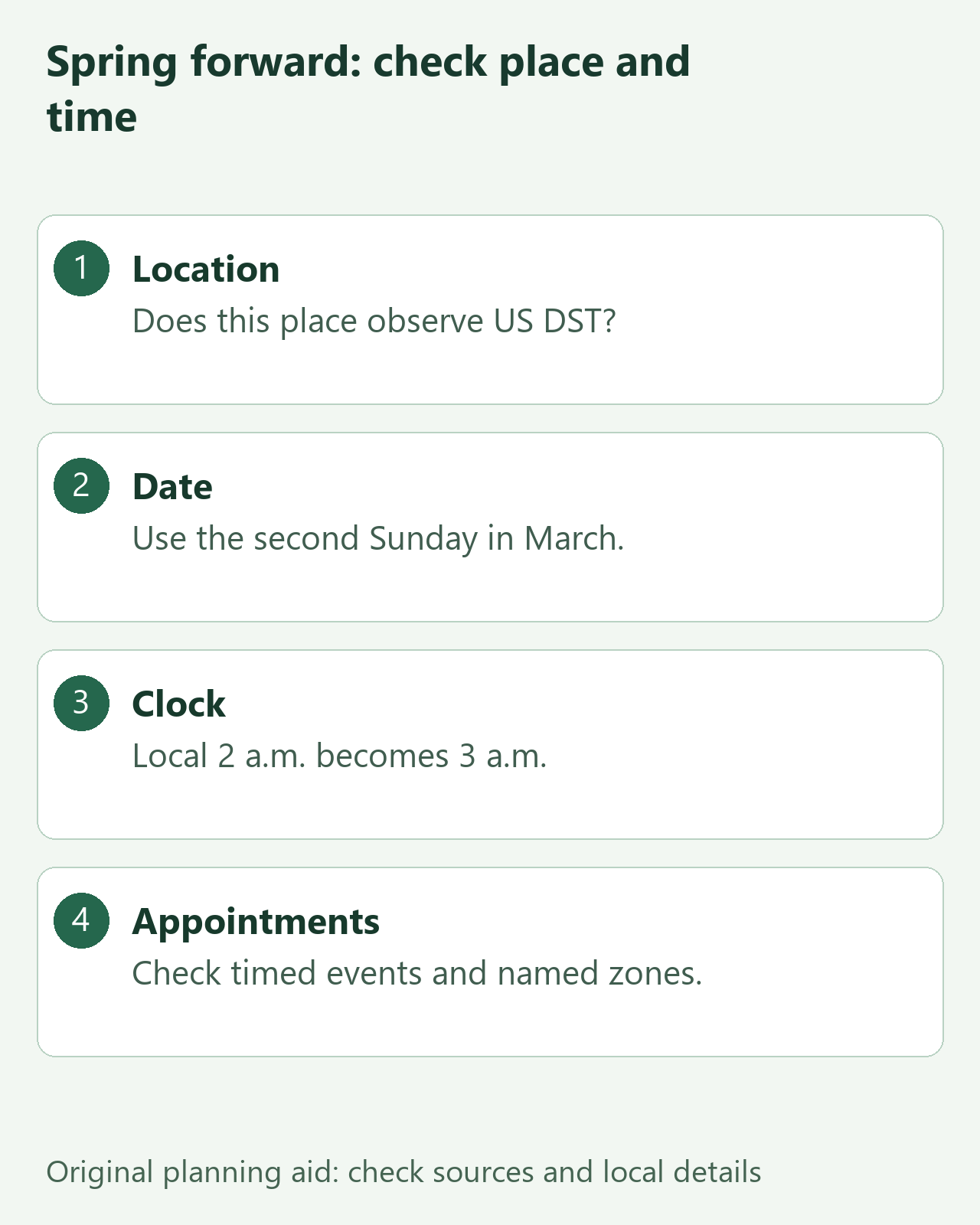
Under the current US rule, daylight saving time starts on the second Sunday in March in places that observe it. At 2 a.m. local standard time, clocks move forward to 3 a.m. The 2027 spring change is Sunday, March 14; most of Arizona and Hawaii do not make this change.
Scope and time basis: Current United States spring clock-change rule, checked against USNO on 2026-11-04. This is not a worldwide DST calendar; future legal changes and local exceptions require checking.
Spring clock-change dates
These dates are computed from the second-Sunday-in-March rule described by the U.S. Naval Observatory. The autumn dates are included to help distinguish “spring forward” from “fall back”; under the current US rule, the autumn change is the first Sunday in November.
| Year | Spring: second Sunday in March | Autumn: first Sunday in November |
|---|---|---|
| 2026 | Sunday, March 8, 2026 | Sunday, November 1, 2026 |
| 2027 | Sunday, March 14, 2027 | Sunday, November 7, 2027 |
| 2028 | Sunday, March 12, 2028 | Sunday, November 5, 2028 |
| 2029 | Sunday, March 11, 2029 | Sunday, November 4, 2029 |
| 2030 | Sunday, March 10, 2030 | Sunday, November 3, 2030 |
What happens to the clock at 2 a.m.?
In a location observing the spring change, 1:59 a.m. is followed by 3:00 a.m. at the transition. The local times from 2:00 through 2:59 do not occur that morning. Do not create a 2:30 a.m. local appointment without checking how the organizer or scheduling system handles a nonexistent time.
The spring change moves the clock ahead one hour. A calendar day containing the transition can have 23 elapsed hours even though it is still one calendar date. Counting calendar days and measuring elapsed hours are different tasks.
Check the location before applying the rule
USNO states that Hawaii and most of Arizona observe standard time only. The second-Sunday-in-March rule therefore does not mean every US clock changes. Countries outside the United States can have different dates, exceptions or no daylight saving time. Use the destination’s rules for a trip or international meeting.
For a recurring meeting, choose the named time zone that matches the intended wall-clock schedule. A fixed UTC offset and a location’s time zone are not interchangeable throughout the year. Check the invitation after the transition rather than assuming participants in every location shift together.
- Confirm whether the event’s location observes daylight saving time.
- Check the spring date for the year.
- Inspect overnight appointments, alarms and scheduled tasks around the missing hour.
- For a cross-zone meeting, preview each participant’s displayed time after the change.
- Check an automatically adjusted device before manually moving its clock a second time.
A time change is not an automatic day off
The spring transition is a clock rule, not an entry on OPM’s list of federal public holidays. Do not infer an office or school closure from it. Overnight work, transport and scheduled services still need their own operational instructions; this guide does not determine pay rules or a transport operator’s timetable.
Worked planning examples
An appointment is entered for 2:30 a.m. on March 14, 2027
In a US location applying the spring transition, that local clock time does not occur. Contact the organizer or check the scheduling instructions for the intended valid time. Do not assume every calendar app resolves the nonexistent time the same way.
A meeting includes New York and Phoenix
New York applies the spring change, while Phoenix remains on standard time. A recurring New York wall-clock meeting can display at a different Phoenix time afterward. Check the named zones and the specific occurrence in the invitation.
A phone already adjusted overnight
Read the current clock and time-zone setting before changing it manually. If automatic date and time already applied the change, adding another hour would put the displayed time ahead incorrectly.
A traveler sees a different spring date abroad
This page describes the US rule. Use the destination’s local source and the airline or organizer’s timed itinerary. Do not substitute the US second Sunday in March for another country’s transition date.
Spring clock-change appointment checklist
Use the optional text record to keep verified dates, sources and local arrangements together. Leave unconfirmed information open. Downloading it does not send your completed notes to this site.
Frequently asked questions
When does US daylight saving time start in 2027?
Sunday, March 14 in places that observe it, at 2 a.m. local standard time.
Do clocks go forward or backward in March?
Forward one hour: 2 a.m. becomes 3 a.m. in locations applying the spring change.
Does every US state change every clock?
No. USNO identifies Hawaii and most of Arizona as observing standard time only. Check the specific location.
Can the future dates change?
The table applies the current rule. A future change in law or local observance could alter the relevant schedule; check before making time-sensitive plans.
Choose the next planning task
Sources and what they support
- USNO: Daylight Saving Time
Current US spring and autumn rules, local clock transitions, and the Hawaii/most-of-Arizona exception. No worldwide calendar is inferred.
- OPM: Federal Holidays
Federal employee holiday list and year-specific usual Monday–Friday observed schedules. It does not establish every business or school schedule.
Source scope and local arrangements matter. Use the relevant organization, agency, calendar authority or astronomy service for the specific decision you are making.